
Euler's Eyes
2026-10-19
Circular functions: the wheel that makes waves
In the interactive book: complete chapter II, with all demonstrations and exercises.
The Ferris wheel cabin
Imagine a Ferris wheel with a center at height zero and a radius equal to one. As the cabin rotates, its height changes. Its horizontal position also changes. Let’s give names to these two measurements.
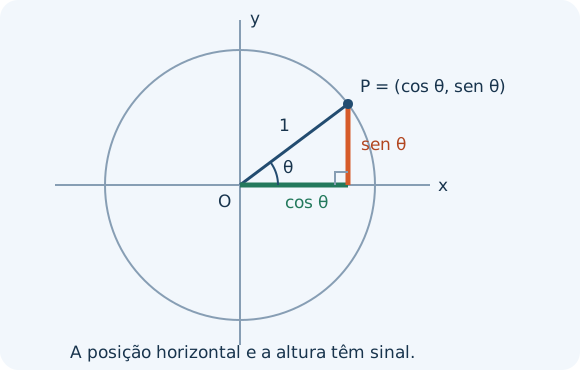
A point on the cycle has coordinates $P=(x,y)$. For the turning angle $\theta$, we define $\cos\theta=x$ and $\operatorname{sen}\theta=y$. Cosine is the horizontal position; sine, the signed height. On the left side, $x$ is negative; below the center, $y$ is negative.
A function is a rule that associates each input in its domain with a single output. For sine and cosine, any real number can be an input in radians; the outputs are between $-1$ and $1$.
From the wheel to the graph
Make a table and place the angle on the horizontal axis and the value of the function on the vertical:
| Spin | $0°$ | $90°$ | $180°$ | $270°$ | $360°$ |
|---|---|---|---|---|---|
| Sine | 0 | 1 | 0 | −1 | 0 |
| Cosine | 1 | 0 | −1 | 0 | 1 |
Between these points, values continually change. Draw a smooth curve. Then repeat the drawing for another round. A function is periodic when the same positive shift in the input repeats all values. The smallest of these shifts, when it exists, is the fundamental period.
Demonstration: why does the wave repeat?
After one turn, the cabin returns to the same point. Therefore, its two coordinates are the same as the previous ones:
$$\operatorname{sen}(\theta+2\pi)=\operatorname{sen}\theta,\qquad \cos(\theta+2\pi)=\cos\theta.$$No positive rotation of less than one revolution maintains the horizontal position of all points: in particular, the cosine only returns to 1 after one complete revolution. For sine, its maximum 1 only reappears after one complete revolution. Thus, both have fundamental period $2\pi$.
Four other functions
The tangent compares the height with the horizontal position:
$$\tan\theta=\frac{\operatorname{sen}\theta}{\cos\theta}.$$It does not exist when the cosine is zero: $\theta=\pi/2+k\pi$. Dividing by zero does not produce a number. The tangent has a period $\pi$: after half a turn, the two coordinates change sign and their quotient remains the same.
Three functions complete the family:
| Function | Definition | When it doesn’t exist |
|---|---|---|
| Cotangent | $\cot\theta=\cos\theta/\operatorname{sen}\theta$ | $\theta=k\pi$ |
| Drying | $\sec\theta=1/\cos\theta$ | $\theta=\pi/2+k\pi$ |
| Cosecant | $\csc\theta=1/\operatorname{sen}\theta$ | $\theta=k\pi$ |
Here and throughout the rest of the book, $k$ represents any integer. Cotangent has period $\pi$; secant and cosecant, $2\pi$. Sine and cosine can be zero; their reciprocals are never zero and have modulus at least 1.
A bigger wheel
If the radius is 4 m and the center is 6 m from the ground, the height of the cabin is $h(\theta)=6+4\operatorname{sen}\theta$. The smallest value is $6-4=2$ m and the largest is $6+4=10$ m. The number 4 is the amplitude of the oscillation around 6. In $f(t)=\operatorname{sen}(2t)$, with $t$ in radians, the period is $\pi$: just $2t$ increases $2\pi$.
In everyday life
- Ferris Wheels. Roda Rico, in São Paulo, is 91 m high; the height of each cabin along the ride is a sinusoid.
- Playground swing. A swing always goes back and forth at the same rhythm, and its position repeats itself as a periodic function.
- Temperature of the day. The temperature rises and falls in a cycle of 24 hours which, on a day without cold fronts, looks like a wave.
Exercises
Try solving it in your notebook before opening the solution. Exercises 1 and 2 are input; 3 and 4, for practice; 5 and 6, for deepening.
1. Give sine and cosine of $270°$.
See resolution 1
The point is $(0,-1)$: $\operatorname{sen}270°=-1$ and $\cos270°=0$.
2. Is there $\tan90°$? Explain.
See resolution 2
No. The expression would be $1/0$, which is not defined.
3. If sine and cosine are worth $\sqrt2/2$, calculate tangent, cotangent, secant and cosecant.
See resolution 3
The quotients are 1; the inverses are $2/\sqrt2=\sqrt2$.
4. What is the fundamental period of $\cos(3t)$?
See resolution 4
$2\pi/3$, because $3(t+2\pi/3)=3t+2\pi$.
5. For the wheel with center at 6 m and radius 4 m, what is the height at $270°$?
See resolution 5
$h=6+4(-1)=2$ m.
6. At what angles between $0°$ and $360°$, including the ends, does the cosecant not exist?
See resolution 6
$0°$, $180°$ and $360°$, because in these angles the sine is zero.