
Euler's Eyes
2026-10-30
The life of Bernhard Riemann
Timeline
- 1826Born on 17 September in Breselenz, in the Kingdom of Hanover, the son of a Lutheran pastor.
- 1846Enters the University of Göttingen to study theology, but soon moves to mathematics.
- 1847Goes to study in Berlin, with Dirichlet, Jacobi, Steiner and Eisenstein.
- 1851Doctorate in Göttingen, supervised by Gauss, with the thesis on complex functions.
- 1854On 10 June, gives his habilitation lecture on the foundations of geometry.
- 1857Publishes the theory of abelian functions and becomes an associate professor.
- 1859Succeeds Dirichlet in the chair at Göttingen and is elected to the Berlin Academy. Publishes the paper on prime numbers.
- 1862Marries Elise Koch. Falls ill with tuberculosis.
- 1866Dies on 20 July in Selasca, Italy, aged 39.
The pastor’s son
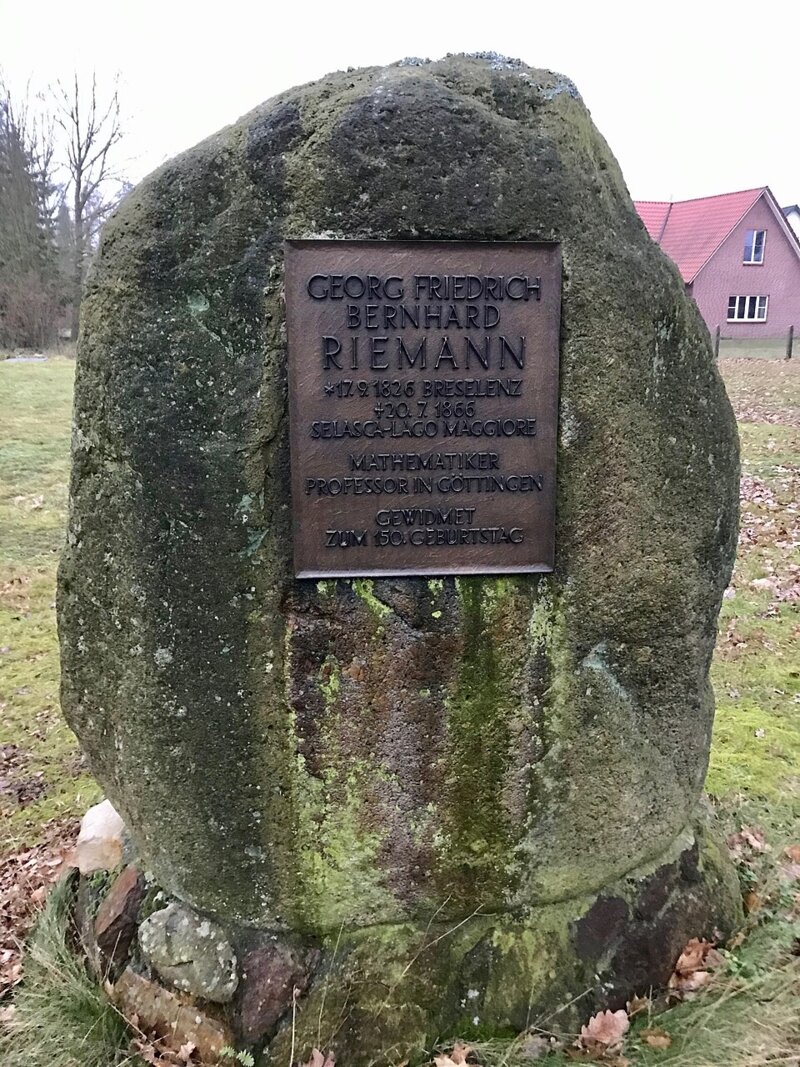
Georg Friedrich Bernhard Riemann was born on 17 September 1826 in Breselenz, a village in the Kingdom of Hanover, in northern Germany. His father, also named Friedrich Bernhard, was a Lutheran pastor who had fought in the wars against Napoleon. The family was poor, and Bernhard was the second of six children. It was his father who taught him until he was ten.
At fourteen he was sent to the Lyceum in Hanover, where he lived with his grandmother; when she died, he moved to the gymnasium in Lüneburg. He was a shy pupil, homesick, and struggled with essay writing. The headmaster noticed his talent for mathematics and lent him books from his library. According to a story told by his biographers, Riemann returned Legendre’s treatise on number theory, almost nine hundred pages long, in less than a week, saying that he had read it.
Theology or mathematics
In 1846 Riemann entered the University of Göttingen to study theology, as his father wished, dreaming of seeing him a pastor. But he attended mathematics lectures, among them those of Gauss, and asked his father’s permission to change course. His father agreed. The next year Riemann went to Berlin, where he studied with Jacobi, Steiner, Eisenstein and, above all, with Peter Gustav Lejeune Dirichlet, who became his model: clear, rigorous, attentive to the ideas behind the calculations.
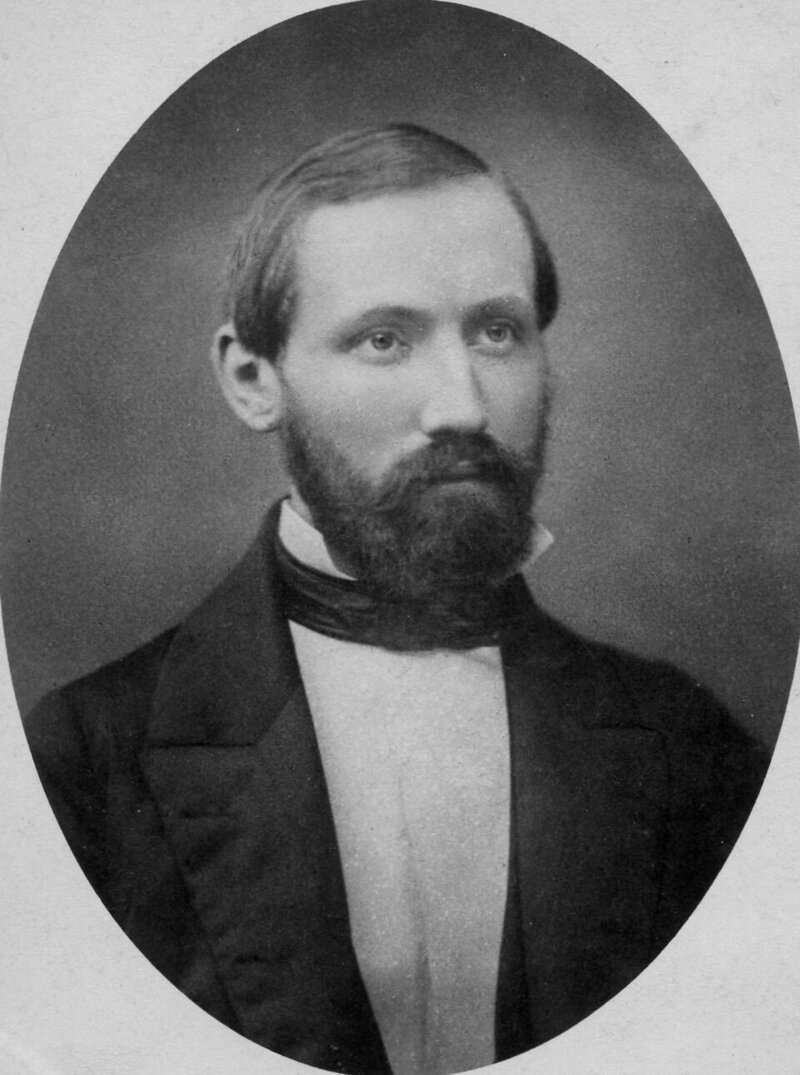
Back in Göttingen in 1849, he worked as an assistant to the physicist Wilhelm Weber and prepared his doctoral thesis, on functions of a complex variable, defended in December 1851. Gauss, who rarely praised anyone, wrote in his report that the work showed “a gloriously fertile originality”. It is in the thesis that Riemann surfaces appear.
The lecture of 1854
To teach at a German university one had to obtain the habilitation: a second written work and a public lecture. The written work, on the representation of functions by trigonometric series, led Riemann to define precisely what an integral is and to discover the rearrangement theorem.
For the lecture, the candidate proposed three topics and the faculty chose one. Riemann offered two on electricity, which he had prepared carefully, and a third on the foundations of geometry, put in almost as a formality. Gauss, against the custom of choosing the first, chose the third. Riemann had to prepare the hardest subject in a hurry, and the lecture, given on 10 June 1854, was one of the most important in the history of geometry. According to Dedekind’s account, Gauss left the room deeply impressed.
Professor in Göttingen
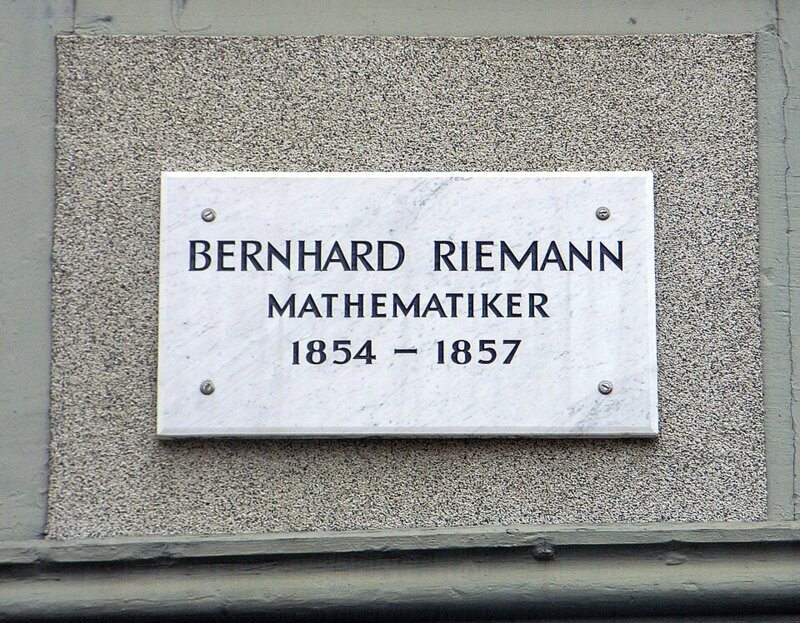
Gauss died in 1855, and Dirichlet came from Berlin to take his chair. Riemann, who lived in hardship as a lecturer without a fixed salary, published the theory of abelian functions in 1857 and was appointed associate professor. When Dirichlet died, in 1859, Riemann was chosen to succeed him: he now held the chair that had been Gauss’s. In the same year he was elected a corresponding member of the Berlin Academy of Sciences and, as was customary, sent the Academy a paper. It was the paper on prime numbers.
The illness
In 1862 Riemann married Elise Koch, a friend of one of his sisters; they had a daughter. A few months after the wedding, a cold turned into tuberculosis. Riemann spent the following winter in Sicily and from then on lived between Göttingen and Italy, in search of a milder climate. In Italy he met mathematicians who admired him, such as Enrico Betti in Pisa.
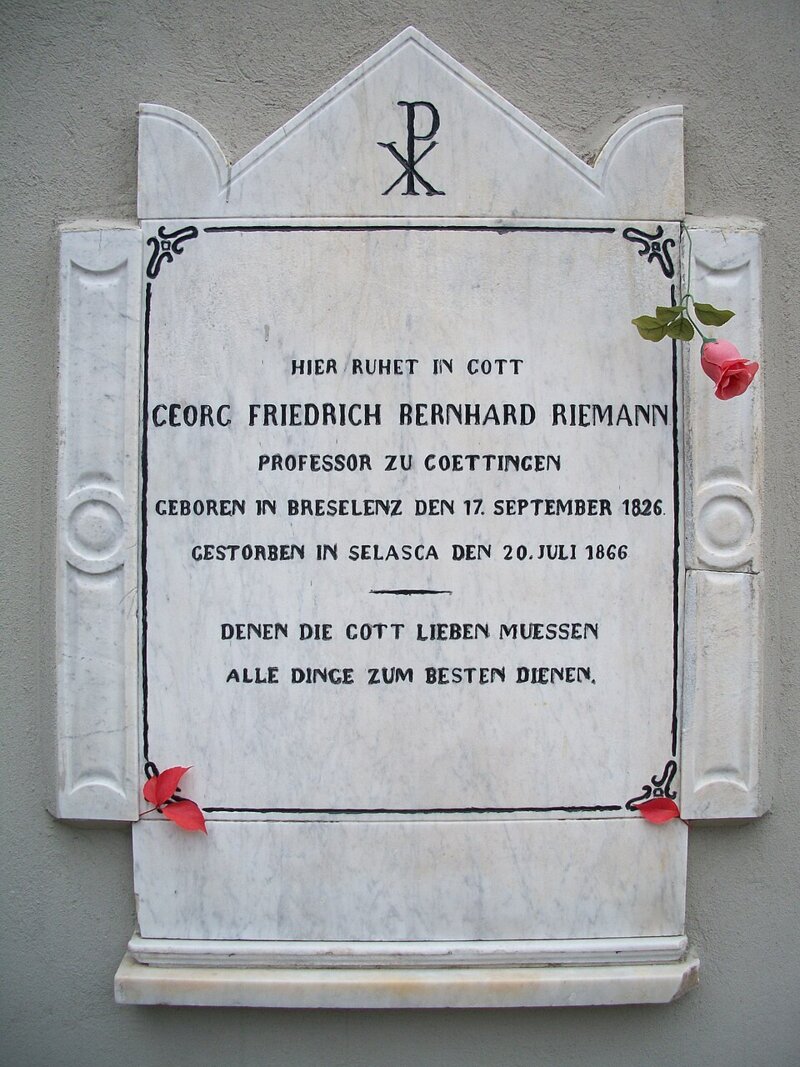
In June 1866, already very ill, Riemann left for Italy for the last time. He settled in Selasca, on the shores of Lake Maggiore. He died there on 20 July 1866, aged 39. He was buried in the cemetery of Biganzolo, nearby. The gravestone bears a verse from the Letter to the Romans: “All things work together for good to them that love God”.
Exercise: a short life
Riemann was born on 17 September 1826 and died on 20 July 1866. How old was he when he died? How old was he at the 1854 lecture and at the paper on primes, presented in November 1859?
In July 1866 he had not yet had his birthday that year: $1866 - 1826 - 1 = 39$ years. In June 1854, $1854 - 1826 - 1 = 27$ years. In November 1859, after his September birthday, $1859 - 1826 = 33$ years.
Exercise: Legendre's book
If Legendre’s treatise had about 860 pages and Riemann read it in six days, how many pages did he read per day? And if he read 8 hours a day, how many minutes did he spend per page?
$\frac{860}{6} \approx 143$ pages per day. In 8 hours, 480 minutes, that gives $\frac{480}{143} \approx 3.4$ minutes per page: fast reading for a text on number theory, which makes the story hard to take literally, but shows the impression the boy made.
Sources: Richard Dedekind, “Bernhard Riemann’s Lebenslauf”, in Bernhard Riemann’s Gesammelte Mathematische Werke (1876) · Detlef Laugwitz, Bernhard Riemann 1826–1866: Turning Points in the Conception of Mathematics (1999) · biography of Riemann, MacTutor · John Derbyshire, Prime Obsession (2003).